As the federal government prepares to unveil its financial roadmap for the coming year, the Budget 2026-27: Government Salary & Pension Increase News is the top concern for millions of public sector employees. In a time of shifting economic policies and international pressures, everyone is asking the same question: will the new pay scales be enough to survive the current cost of living? With inflation in April 2026 recorded at a sharp 10.9% to 11.5%, the gap between income and expenses is widening. Initial reports from the Finance Division suggest that while a relief package is on the table, it might be more modest than in previous years due to strict oversight from global lenders.
Table of Contents
Government Salary & Pension Increase
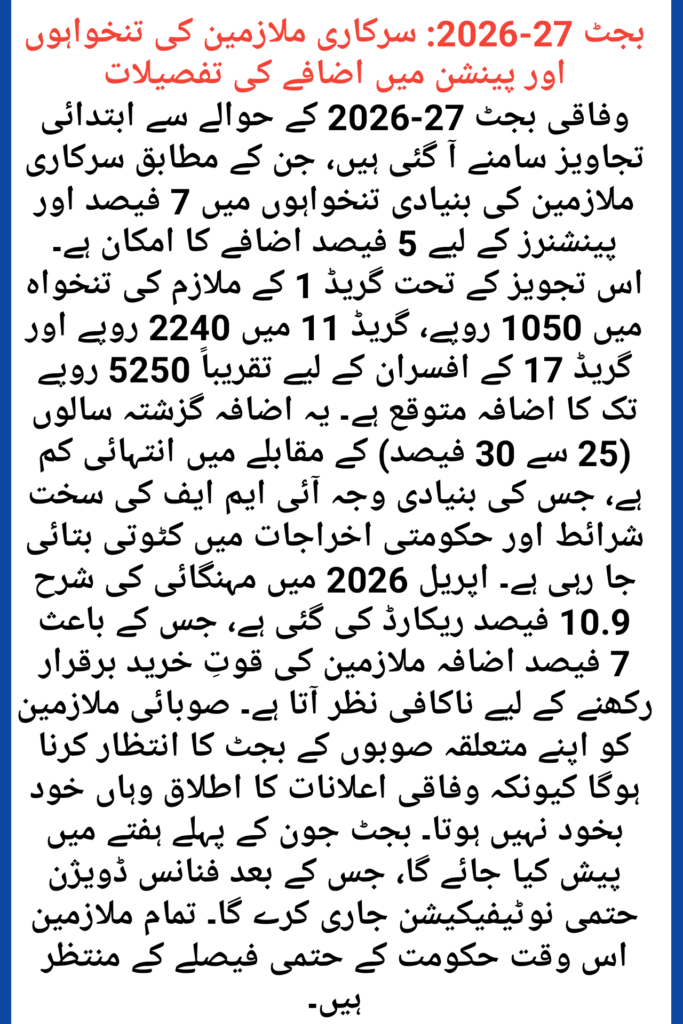
The upcoming federal budget, expected to be presented in the National Assembly during the first week of June, is being designed under the shadow of a concluding IMF Extended Fund Facility. Sources close to the Ministry of Finance indicate that the government is considering a 7% increase in basic salaries for civil servants and a 5% hike in net pensions for retired employees. This proposal is currently being debated as part of the “Budget Strategy Paper 2026-27,” which aims to balance public relief with the need to reduce the national fiscal deficit.
For many, this news is bittersweet. While any increase is a positive step, the proposed percentages are significantly lower than the 25–30% raises seen in the last two budget cycles. The primary reason behind this cautious approach is the government’s commitment to the IMF to freeze or limit non-development expenditures, including the massive public sector wage bill.
Expected Grade-Wise Salary Increase Breakdown
To understand how these percentages translate into actual take-home pay, we have to look at the basic pay scales. It is important to remember that these increases usually apply only to the Basic Pay, not the entire gross salary which includes various allowances.
| Basic Pay Grade (BPS) | Current Avg. Basic Pay (Estimate) | Expected 7% Increase |
| Grade 1 to 5 | Rs. 15,000 – 20,000 | Rs. 1,050 – 1,400 |
| Grade 11 to 16 | Rs. 32,000 – 50,000 | Rs. 2,240 – 3,500 |
| Grade 17 to 19 | Rs. 75,000 – 120,000 | Rs. 5,250 – 8,400 |
Impact on Pensioners
Retired employees, who often feel the pinch of inflation the hardest, are looking at a 5% increase in net pension. While this provides some cushion, the rising costs of medicines and utilities in 2026—driven by a 50% surge in high-speed diesel and electricity tariff adjustments—mean that most pensioners will still find it difficult to maintain their purchasing power.
The Role of IMF and Provincial Budgets
One of the biggest hurdles for the 2026-27 budget is the “11 New Conditions” reportedly introduced by the IMF. These conditions focus on withdrawing tax exemptions and increasing energy prices to market levels. Because the federal government is under pressure to show “fiscal discipline,” they are keeping a tight lid on salary increments.
Furthermore, provincial employees in Punjab, Sindh, KPK, and Balochistan must wait for their respective provincial assemblies to announce their budgets. While provinces usually follow the federal lead, it is not an automatic process. Each province evaluates its own revenue collection before issuing a formal notification from its Finance Department.
Inflation vs. Salary Growth
- 2023-24: 30% Salary Increase
- 2024-25: 25% Salary Increase
- 2026-27 (Proposed): 7% Salary Increase
- Current Inflation (April 2026): ~11%
This comparison shows a clear “Real Income Gap.” If the cost of goods rises by 11% while salaries only rise by 7%, the average government employee is effectively taking a 4% pay cut in terms of what they can actually buy.
Frequently Asked Questions (FAQs)
When will the official notification for the salary increase be issued?
The official notification is typically issued by the Finance Division in late June or early July, shortly after the Finance Bill is passed by the Parliament. The new rates usually take effect from July 1st, 2026.
Is this 7% increase confirmed for all employees?
No, it is currently a “proposal” within the budget strategy. The final percentage can change during the parliamentary budget debates. Representatives of various clerk associations (like APCA) are already negotiating for a higher percentage (15–20%) to match the 11% inflation rate.
Will the Adhoc Relief Allowances be merged into the basic pay?
There is a long-standing demand to merge old Adhoc allowances into the basic pay to create a “2026 Pay Scale.” However, the government has not yet confirmed if this will happen in the current budget due to the increased pension liability it would create.
Does this increase apply to private-sector employees?
No, the federal budget only directly affects government employees and pensioners. However, the government usually announces a new Minimum Wage in the budget (expected to be around Rs. 37,000–40,000 in 2026), which private employers are legally required to follow.