Bahria Town Crisis 2025, The High Stakes Clash That Could Reshape Pakistan’s Real Estate Future
A Crisis That Breaks Beyond Real Estate
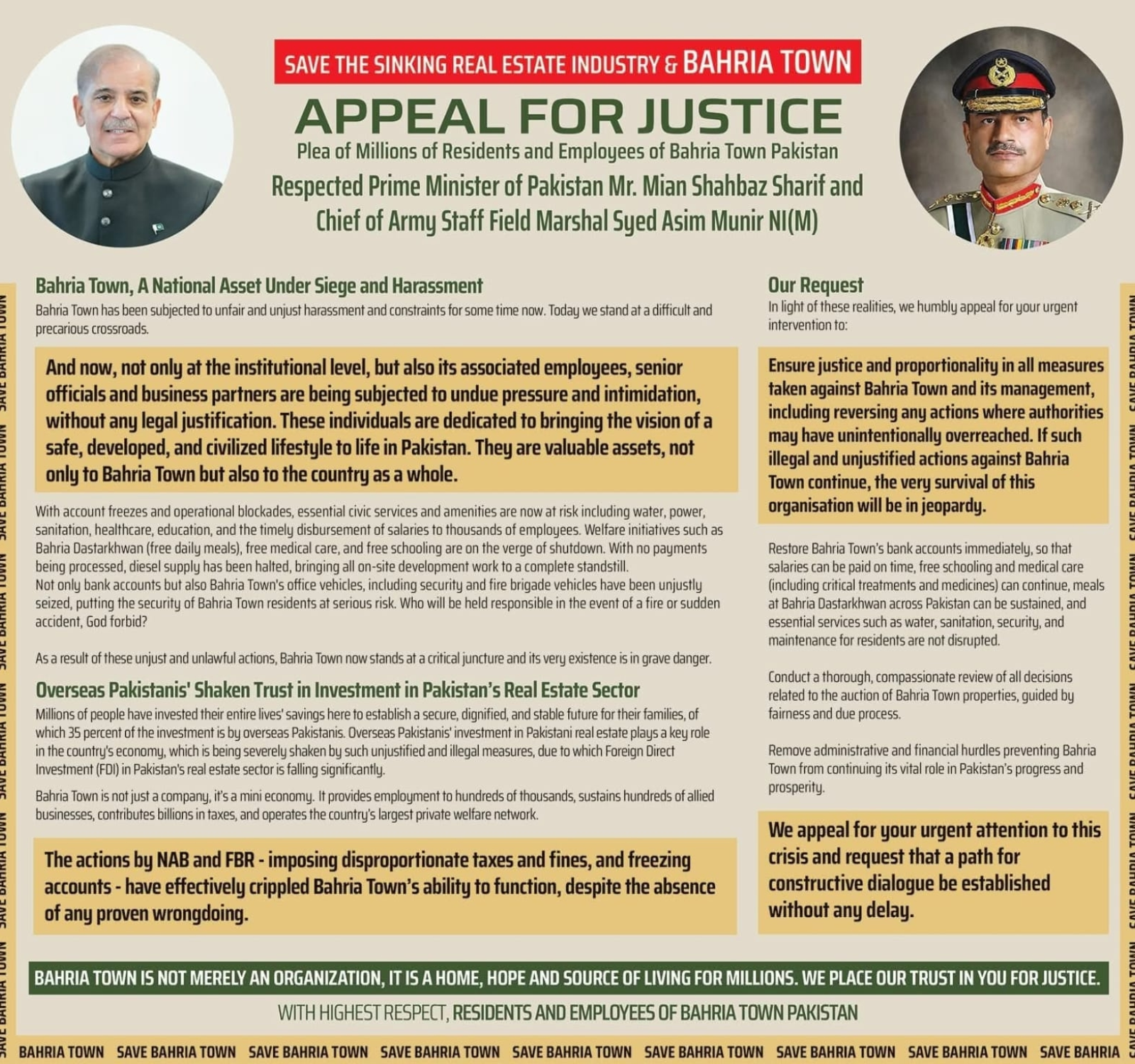
In a dramatic turn that has shaken Pakistan’s real estate sector to its core, residents and employees of Bahria Town Pakistan have issued an unprecedented appeal to the Prime Minister and Chief of Army Staff, warning that the country’s most recognizable private housing brand is now on the brink of operational paralysis. With bank accounts frozen, assets seized, and welfare programs halted, the crisis is no longer just about a developer’s legal troubles it has become a national economic flashpoint affecting millions.
The public appeal, splashed across major digital platforms, frames Bahria Town’s situation as a “national asset under siege”, arguing that aggressive actions by NAB and FBR have unintentionally endangered essential services such as water, sanitation, healthcare, education, and emergency response. The message is blunt: if this deadlock continues, Pakistan could face one of its most destabilizing property shocks in decades, with overseas investors already pulling back and domestic confidence evaporating.
This is not merely a dispute between a developer and the state; it is a collision of accountability, economics, and human impact, unfolding in real time. And the fallout is spreading far beyond the boundary walls of Bahria Town.
What Triggered the Bahria Town Appeal?
The crisis did not erupt overnight. It is the culmination of years of intensifying legal scrutiny, land disputes, and aggressive regulatory action now reaching a boiling point that residents describe as “institutional suffocation.” Bahria Town, once marketed as the model of master-planned living in Pakistan, is today caught in a web of freezing orders, tax demands, and criminal investigations targeting its financial operations and senior leadership.
At the heart of the current standoff are broad-based actions initiated by NAB and FBR, including the freezing of Bahria Town’s accounts, seizure of vehicles and operational assets, and the shutdown of financial flows critical to running vast housing communities. While the authorities argue these measures are necessary to address alleged misappropriation, land irregularities, and massive unpaid dues, Bahria Town’s residents insist the crackdown has overstepped into collective punishment, paralysing services relied upon by millions.
Tensions escalated sharply when essential operations such as water supply, waste management, maintenance teams, and welfare programs began grinding to a halt. Construction payments stalled. Salaries were delayed. Welfare initiatives like free schooling, Dastarkhwan services, and medical care stood at the edge of collapse.
Faced with this paralysis, Bahria Town’s residents and employees took an unprecedented step: a public, nation-wide appeal addressed not just to the civilian leadership but to the country’s top military command. Their message is unmistakable this is no longer a corporate dispute but a systemic emergency that threatens public trust, economic stability, and the functioning of Pakistan’s largest private housing ecosystem.
A Coordinated Plea From a Community Under Pressure
The public appeal circulated by Bahria Town residents and employees is not a routine complaint it is a full-scale SOS, crafted with urgency and directed at the highest offices in the country. The language is deliberate, forceful, and framed as a last resort after “unjust harassment,” “operational suffocation,” and “institutional overreach” have pushed the housing empire into existential danger.
“A National Asset Under Siege”: The Core Message
The ad positions Bahria Town as a national asset, not merely a private developer. It argues that the ongoing constraints freezing of accounts, seizure of vehicles, halting of payrolls, and disruption of essential municipal functions have undermined the very infrastructure that supports hundreds of thousands of residents. By framing Bahria Town as a stabilizing force that offers clean water, reliable power, advanced sanitation, schools, hospitals, and welfare programs, the appeal attempts to shift the narrative: this is not about protecting a corporation, but protecting the people living inside it.
Residents emphasize that the sudden chokehold on operations has jeopardized everything from routine maintenance to life-saving emergency services. Fire brigade assets have reportedly been seized. Medical facilities face supply shortages. Welfare programs like Bahria Dastarkhwan and free educational services are at risk of shutdown. What was once Pakistan’s flagship model of privatized urban living is described as being pushed into forced collapse.
Accusations of “Disproportionate and Unjustified Actions”
The appeal strongly criticizes the “disproportionate” measures taken by NAB and FBR, alleging that sweeping actions have been executed without due process, clarity, or demonstrated wrongdoing. According to the text, the crackdown has created more victims than solutions punishing employees, residents, foreign investors, and service users rather than those allegedly responsible for mismanagement.
It specifically highlights that:
Salaries for thousands of employees have been frozen, threatening livelihoods.
Critical welfare and healthcare services are nearing shutdown, leaving vulnerable families exposed.
Construction activities and payments have stalled, destabilizing the wider real estate supply chain.
Bank accounts across multiple projects remain blocked, crippling internal operations.
The framing is intentional: the residents are not asking for immunity for Bahria Town’s leadership. They are asking for proportionality a system where investigations continue, but not at the cost of collapsing an entire ecosystem of people, services, and investments.
A Direct Challenge to the State’s Approach
By appealing simultaneously to the Prime Minister and the Chief of Army Staff, the residents have signaled that they view this crisis as transcending bureaucratic procedure. It is a strategic public escalation a challenge to the state to re-evaluate whether its pursuit of accountability has inadvertently created a humanitarian and economic emergency.
The narrative is clear: if the state intends to pursue justice, it must do so in a manner that does not dismantle the lives of those who had no role in creating the legal disputes.
How the Asset Freeze Is Hitting Daily Life in Bahria Town
For years, Bahria Town marketed itself as the gold standard of private city making in Pakistan reliable utilities, manicured landscapes, clean streets, uninterrupted power, and a sense of order rarely found in urban Pakistan. But today, according to residents, that carefully engineered ecosystem is cracking under the weight of financial paralysis. When bank accounts freeze, the lifeblood of a privately run city freezes with it.
Essential Services at Risk: Water, Power, Sanitation, Security
Unlike traditional urban centers dependent on municipal governments, Bahria Town operates like a self funded micro city, where everything from water treatment plants to street lighting, garbage disposal, landscaping, and security patrols is run internally. With operational accounts blocked, these systems have begun to strain.
Residents report interruptions in:
Water supply operations, reliant on continued fuel, pumping, and maintenance spending.
Waste management cycles, threatening hygiene and public health.
Electricity infrastructure maintenance, with repair teams increasingly constrained.
Security services, whose salaries and equipment are tied to halted payments.
When the financial machinery of a city stops moving, the physical machinery follows.
Fire Brigades, Emergency Response & Medical Care Under Threat
Perhaps most alarming is the seizure of fire brigade vehicles, as mentioned in the public appeal. In a community that relies on internal emergency services not municipal ones this creates a direct safety risk. A delayed response in a high-density residential area can mean the difference between containment and catastrophe.
Medical clinics and hospitals inside Bahria Town also report disrupted supply chains, as vendors will not deliver medicines, equipment, and consumables unless payments resume. In a community of hundreds of thousands, this is not an inconvenience it is a public health threat.
Salaries Frozen: The Human Fallout Begins
Thousands of employees from janitorial staff to engineers, teachers, paramedics, maintenance teams, drivers, and security personnel depend on Bahria Town’s internal payroll system. With accounts frozen, salary disbursement has stalled, dragging hundreds of families into financial distress.
Residents warn that if the deadlock continues:
Teachers may abandon classrooms.
Doctors may leave clinics.
Security staff may walk off duty.
Maintenance crews may halt critical repairs.
This is how the collapse of a city begins not with a dramatic explosion, but with thousands of quiet departures.
Welfare Programs on the Brink of Shutdown
Bahria Town’s welfare ecosystem, including Bahria Dastarkhwan, free medical camps, and free schooling initiatives, is fueled entirely by internal funding. These programs serve low-income workers, daily wage earners, support staff, and dependents who rely on subsidized meals, medicines, and education.
With accounts frozen:
Dastarkhwan meals are being reduced or suspended.
Free schooling programs face interruption.
Welfare medical centers are unable to purchase essential supplies.
For the most vulnerable, Bahria’s paralysis is not a legal battle it is a battle for survival.
Construction Halts & Supplier Shocks: The Wider Economic Ripple
Every incomplete building, unpaid contractor, and stalled purchase order triggers ripple effects across the real estate supply chain. Cement suppliers, steel vendors, electricians, plumbers, carpenters, HVAC technicians, and transporters all connected to Bahria Town’s massive footprint are now confronting:
Unpaid invoices
Paused development work
Contract uncertainty
Layoffs and closures
Pakistan’s real estate market, already reeling from inflation and declining buyer confidence, is now facing its most destabilizing shock in years.
The message from residents is stark: the continued freeze is not just punishing Bahria Town it is punishing the ecosystem that keeps Pakistan’s real estate engine running.
Overseas Pakistanis Fear for Their Life Savings
If Bahria Town’s internal paralysis is a domestic emergency, its reputational collapse among overseas Pakistanis is an international one. For decades, expatriates from the Gulf, Europe, the UK, Australia, and North America have poured billions into Bahria Town properties, viewing them as safer, more transparent alternatives to chaotic urban real estate markets. Today, that confidence is evaporating at a pace that alarms both investors and analysts.
A Third of Bahria Town’s Market Is Driven by the Diaspora
According to residents, nearly one-third of Bahria Town’s entire investment base comes from overseas Pakistanis. These are individuals who:
send remittances back home,
purchase residential plots for future retirement,
invest in files, apartments, and villas,
diversify savings by converting foreign earnings into real estate assets.
For many, Bahria Town was the closest thing Pakistan offered to a “guaranteed lifestyle investment.” Gated security, consistent utilities, modern infrastructure, and a name recognized globally made it a magnet for diaspora capital.
But the current crisis bank accounts frozen, projects stalled, and legal battles intensifying has triggered the worst instinct any investor can have:
fear.
From Confidence to Panic: A Sudden Market Freeze
In diaspora WhatsApp groups, Facebook forums, and investment circles, the mood has shifted from cautious optimism to open anxiety. Overseas Pakistanis who once bought Bahria properties sight unseen are now hesitating to even transfer token payments. File markets have slowed. Sellers are desperate. Buyers are staying away.
The fear is driven by three questions no authority has answered clearly:
Will Bahria Town projects be completed?
Will property transfers, NOCs, and development work resume?
Will the state provide a path of security for genuine buyers?
The absence of answers has created a vacuum filled by speculation and markets hate speculation more than they hate bad news.
A Blow to Pakistan’s Fragile Real Estate Reputation
For years, overseas Pakistanis have complained about the insecurity of investing in local property markets fraudulent schemes, fake files, double allotments, and stalled societies. Bahria Town, despite controversies, still symbolized scale, structure, and delivery.
Now, with operations crippled and the developer entangled in a high-stakes confrontation with state institutions, overseas Pakistanis see a familiar pattern:
when political and institutional conflict erupts, consumer protection evaporates.
This crisis doesn’t just threaten Bahria Town’s market it threatens Pakistan’s entire foreign-invested real estate pipeline.
The Diaspora’s Message: “We Don’t Want Impunity; We Want Stability.”
In discussions monitored across multiple diaspora forums, a recurring theme emerges:
diaspora Pakistanis are not defending alleged wrongdoing by any developer.
They are demanding:
clarity,
proportionality,
timelines for resolution,
and protection of innocent buyers.
Their fear is simple but legitimate:
If an entire city can be frozen overnight, what guarantees does any investor have?
As one overseas investor put it bluntly:
“If Bahria Town collapses, every real estate investment in Pakistan becomes a gamble.”
The state may not have intended to shatter investor confidence but unless the deadlock breaks soon, the damage could extend far beyond the boundary walls of Bahria Town.
Allegations of Fraud, Land Grabbing & Illicit Gains
While Bahria Town’s residents frame the crisis as an institutional overreach, the state particularly the National Accountability Bureau (NAB) presents a dramatically different narrative. To NAB, this is not a story of persecution but of accountability catching up with one of Pakistan’s most controversial real estate empires.
The clash between these two narratives is exactly where the national deadlock now sits.
The Core of NAB’s Allegations: Illegal Land Acquisition & Massive Irregularities
For over a decade, NAB has pursued numerous cases against Bahria Town and its leadership, focusing on claims that the developer acquired public and private lands through:
illegal allotments,
unauthorized conversions of agricultural land,
manipulated exchanges of state-owned land,
collusion with government officials,
and misleading of buyers through unapproved housing schemes.
NAB maintains that Bahria Town’s expansion often took place through irregular channels, bypassing zoning laws, encroaching on forest or government land, or securing land titles through backdoor influence.
To the Bureau, this is not a case of over-enforcement it is a case of finally enforcing laws that were ignored for too long.
Why NAB Froze Bahria Town’s Accounts: A Strategy to Secure Potential Recoveries
NAB argues that freezing assets and bank accounts is not punitive it is preventive. The Bureau’s justification includes:
preventing alleged illicit funds from being transferred offshore,
securing billions in potential recoveries mandated by courts,
preserving assets until accountability courts deliver final judgments,
ensuring that affected citizens may be compensated if wrongdoing is proven.
To NAB, the freeze is necessary to stop what it believes could be large-scale financial flight, especially at a time when senior Bahria Town leadership is already under scrutiny or in hiding.
The Supreme Court Chapter: A Billion-Rupee Precedent
One of the defining moments in this long-running saga was the Supreme Court’s settlement in the Bahria Town Karachi case, where the developer agreed to pay a staggering
Rs. 460 billion
for land regularization.
While the deal was historic, it also set a precedent one that reinforced NAB’s belief that Bahria Town’s land acquisition practices were deeply flawed and required strong intervention.
Over subsequent years, NAB has treated this settlement not as closure, but as evidence that serious irregularities existed across other Bahria projects as well.
NAB’s View of Consumers: “We Are Protecting the Public, Not Targeting It.”
In public statements, NAB insists that its actions aim to safeguard the rights of ordinary buyers especially those who invested in housing schemes that were launched without lawful approvals or on disputed land.
From NAB’s standpoint:
If a project is illegal, buyers must be protected from further losses.
If a developer has created irregularities, accountability must be enforced.
If billions of rupees are in question, securing assets is essential.
The Bureau rejects the idea that its actions constitute harassment. Instead, it argues that impunity for mega-developers is what destabilizes Pakistan’s investment climate not accountability.
Where NAB’s Position Intersects With the Crisis
The challenge and the contradiction is this:
While NAB seeks accountability, the methods used to enforce it have unintentionally triggered a system-wide freeze that affects:
residents,
employees,
daily operations,
welfare services,
and investor confidence.
The Bureau’s defense is clear:
“We are enforcing the law; the fallout is the consequence of illegal practices, not our actions.”
This clash of narratives justice versus collapse is now the core dilemma facing Pakistan’s political and economic leadership.
The state’s question is no longer whether to pursue accountability.
It is how to pursue accountability without collapsing an entire urban ecosystem in the process.
Real Estate at a Crossroads, What’s at Stake for Pakistan’s Economy
The crisis unfolding inside Bahria Town is not an isolated scandal it is a systemic tremor shaking the foundations of Pakistan’s real estate economy. What began as a legal confrontation has now evolved into a national stress test:
Can Pakistan pursue high level accountability without triggering an economic contagion?
A Shock to an Already Fragile Property Market
Pakistan’s real estate sector has been under severe pressure for years crippling inflation, record-high construction costs, stagnant middle-class purchasing power, and investor flight.
But the Bahria Town deadlock has added something far more destabilizing:
uncertainty.
Markets can survive inflation.
They can survive slowdowns.
What they cannot survive is unpredictability especially unpredictability driven by institutional conflict.
The freeze on Bahria Town operations has led to:
transactional paralysis,
rapid decline in plot and file prices,
a buyer exodus,
and shrinking liquidity across major investment hubs.
Dealers report the slowest activity in years. Listings keep increasing. Offers keep dropping.
When a giant falls especially one holding the confidence of millions it does not fall alone. It drags the market with it.
FDI at Risk: The Diaspora Is Watching Very Closely
Pakistan’s foreign direct investment in real estate hinges overwhelmingly on diaspora trust.
When overseas Pakistanis see a major developer’s accounts frozen overnight, construction halted, and legal uncertainty swirling, they react in one predictable way:
they stop sending money.
The Bahria crisis sends a dangerous signal to international investors:
If laws change unpredictably,
If projects can be stalled indefinitely,
If consumer protections are unclear,
If approvals can be revoked overnight,
Pakistan becomes an uninvestable market.
In a country where remittances and diaspora spending are critical economic oxygen, this crisis risks choking one of the nation’s most reliable financial arteries.
The Employment Chain: Thousands at the Brink
Bahria Town is not just a property developer it is a mega employer.
When its operations stall, an entire universe of dependent industries begins to suffocate:
construction labourers,
electricians,
plumbers,
carpenters,
HVAC specialists,
steel and cement vendors,
transport companies,
security firms,
landscapers,
maintenance contractors.
Each halted project is a hundred lost jobs. Each frozen account is a hundred unpaid families.
In an economy already suffering from record unemployment, the Bahria freeze is not a legal event it is an employment shockwave.
Pakistan’s Urban Future at Risk
Bahria Town whatever its controversies introduced something Pakistan desperately lacked:
master-planned infrastructure,
organized utility management,
large-scale private city operations,
and an international-quality residential model.
If its collapse becomes a blueprint, Pakistan could see:
a retreat from large-scale private development,
capital flight from high-end projects,
hesitation from international investors,
abandonment of new city-scale proposals,
and decades-long delays in modern urban planning.
In a country already struggling with urban chaos, this crisis risks rolling back 15 years of developmental momentum.
The Real Question: Accountability or Collapse?
The broader dilemma is now impossible to ignore:
Can Pakistan enforce accountability without strangling the economic ecosystem?
Can institutions pursue justice without destroying investor confidence?
Can the state differentiate between punishing wrongdoing and punishing residents?
Until these questions are answered, the crisis will continue rippling outward through markets, through communities, and through the fragile architecture of Pakistan’s economic survival.
The Bottom Line, Pakistan Must Choose Between Deadlock and Stability
The crisis engulfing Bahria Town is no longer a dispute between a developer and the state. It has grown into a national inflection point a moment that forces Pakistan to confront a deeper truth about its governance, its economy, and its ability to balance justice with stability.
What began as an accountability drive has now produced a chain reaction affecting:
residents who had nothing to do with land decisions,
employees whose salaries are frozen,
overseas Pakistanis whose confidence is shaken,
suppliers and contractors whose livelihoods are collapsing,
and a real estate market already on its knees.
The question is no longer whether Bahria Town followed the law in every case those issues must continue through courts.
The question now is whether Pakistan can enforce accountability without destroying the very people it claims to protect.
A Crisis With No Villains Only Victims and Stakes
NAB insists it is protecting the public.
Residents insist they are being punished for crimes they did not commit.
The state insists it must follow the law.
Investors insist they need stability, not shock therapy.
Everyone claims to be acting in the national interest.
Yet the national interest itself is bleeding.
This is the paradox Pakistan must confront:
Accountability without strategy becomes collateral damage.
Enforcement without proportionality becomes economic suicide.
A Path Forward Exists But Only Through Coordination, Not Confrontation
Pakistan does not need to choose between law and livelihoods.
It needs to choose between:
a frozen megacity and a managed transition,
panic-driven markets and a controlled resolution,
institutional overreach and institutional coordination.
A practical path forward could include:
Unfreezing operational accounts under strict monitoring so services continue.
Allowing welfare, salaries, and essential operations to run independently of legal battles.
Fast-tracking judicial timelines to prevent indefinite uncertainty.
Creating a resident-protection mechanism for all ongoing and future projects.
Launching a transparent public briefing to clarify the roadmap and calm investors.
None of these steps compromise accountability.
They simply prevent accountability from collapsing an entire urban ecosystem.
Why This Crisis Matters Far Beyond Bahria Town
If this deadlock remains unresolved, Pakistan risks triggering:
long-term investor flight,
stalled urban development,
reduced foreign remittances,
a housing market freeze,
and widespread job losses.
In a fragile economy, one domino can topple the line.
Right now, Bahria Town is not just a domino it is the largest tile in the entire structure.
The Final Word
- The Bahria Town crisis is a test not of a developer’s power, but of the state’s judgment.
- It is a test of whether Pakistan can prove that accountability and economic stability can coexist.
- It is a test of whether institutions can act with force and foresight.
- It is a test of whether the voices of residents, workers, and overseas Pakistanis matter when the stakes grow national.
The appeal issued by Bahria Town’s community ends with a plea.
The crisis itself ends with a choice.
Pakistan must decide:
Will it resolve this crisis through coordination and clarity or allow a mega-development to collapse in slow motion, taking economic confidence with it?
The world is watching. And so are the millions whose lives, savings, and futures are tied to the decisions made in the days ahead.