
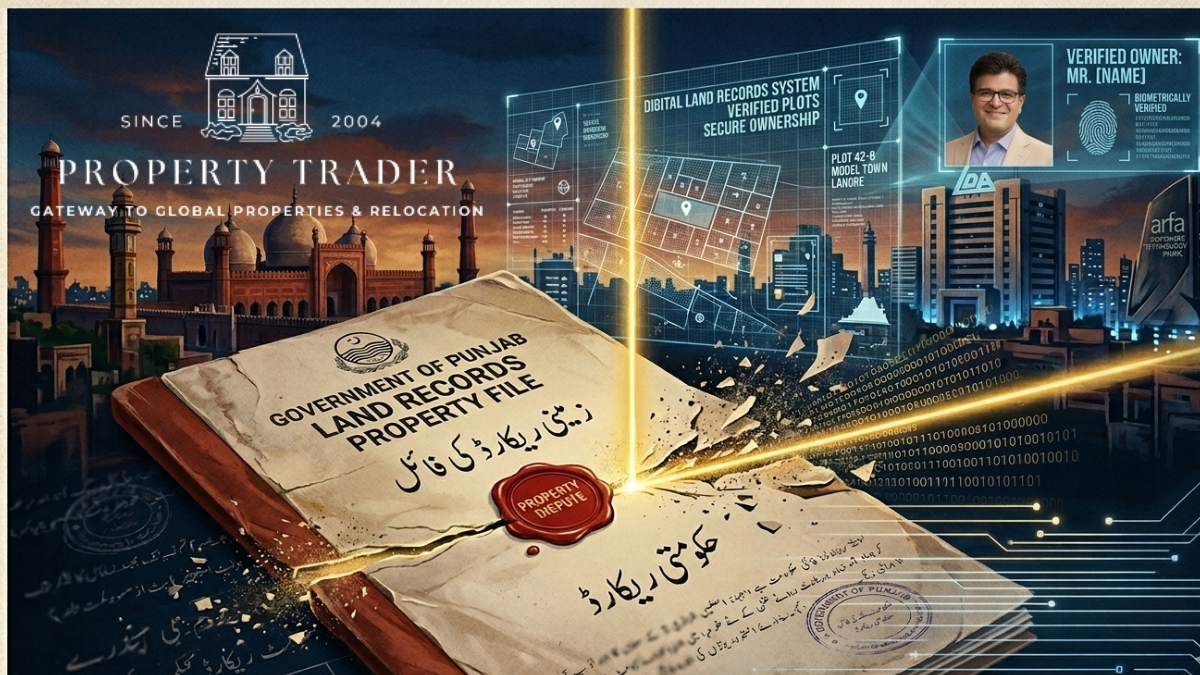
Punjab Ends the File Raj: New Rules to Stop Real Estate Fraud in Pakistan
The Punjab government has mandated digital HSMS registration and PLRA-verified location IDs for every plot transaction ending the paper file system that enabled Pakistan's most pervasive property fraud for decades.
For millions of Pakistanis, the dream of owning a plot of land has long come packaged in a single sheet of paper a property "file." For decades, that file was a promise: your future home in a housing scheme still being carved from farmland on the outskirts of Lahore, Rawalpindi, or Faisalabad. It was also, far too often, a lie.
The same file could be printed twice, sold to a second buyer in a separate transaction, or issued against land the developer never actually owned. Buyers including tens of thousands of overseas Pakistanis sending savings from the Gulf, Europe, and North America — lost billions of rupees to an industry where paper carried more weight than ground reality.
Punjab has now moved to end it.
- All plot purchases in Punjab must now be registered on the Housing Schemes Management System (HSMS)
- Buyers must receive an official letter from the Punjab Land Records Authority (PLRA) with a verified location ID paper files are no longer valid
- Trading of illegal plots and benami (unregistered) files is no longer possible under HSMS
- The Punjab Protection of Ownership of Immovable Property (Amendment) Ordinance 2026 prescribes 5–10 years imprisonment for fraud-based land seizures
- Fines of up to PKR 1 crore apply for convicted offenders
- Dispute resolution committees must close cases within 90 days
What Punjab's New Rules Actually Say
In a high-level Board of Revenue meeting chaired by Punjab Housing Minister Bilal Yasin, the provincial government reviewed proposed legislation and LDA law amendments specifically aimed at closing the loopholes that property fraudsters have exploited for years.
The headline change: all plot buying and selling in Punjab is now linked to the Housing Schemes Management System (HSMS). A transaction can only proceed if the plot has a verified location ID and the buyer holds an official letter issued by the Punjab Land Records Authority (PLRA). Physical files the paper-based documents that defined Pakistan's secondary property market are no longer a legally recognised basis for a transaction.
The Local Government Department, RUDA (Ravi Urban Development Authority), and all housing scheme regulators have been directed to align their operations with the new legal framework.
Punjab Housing Minister Bilal Yasin
What Is a Property File and How Was It Abused?
A "property file" is a paper certificate issued by a housing developer, representing a buyer's claim to a specific or unspecified plot in a future scheme. Because files existed entirely outside digital land record systems, a single plot could have multiple files in circulation simultaneously. Fraudulent developers issued files for phantom plots, sold the same file to multiple buyers, or ran pre-launch campaigns on land without NOC approvals often disappearing with funds before any development began. The file system was not inherently illegal, but its lack of verification infrastructure made it the primary vehicle for organised real estate fraud in Pakistan.
The Broader Legal Architecture: Punjab's 2026 Property Ordinance
The HSMS mandate sits within a larger legislative overhaul. On 17 February 2026, the Punjab Governor promulgated the Punjab Protection of Ownership of Immovable Property (Amendment) Ordinance 2026 — a landmark law that strengthens ownership protections and sharpens penalties across the board.
Under the ordinance, anyone convicted of illegal property seizure through fraud, forgery, or force faces five to ten years in prison and a fine of up to PKR 1 crore. Dispute Resolution Committees are mandated to resolve land cases within 90 days, with a further 90-day window for tribunal appeals a structural attempt to end the decade-long backlog that fraudsters relied on to outlast their victims.
This is the second iteration of the legislation. An earlier 2025 version was suspended by the Lahore High Court over due process concerns. The 2026 amendment addressed those constitutional objections, clearing the path for full enforcement.
Who Wins and Who Resists
The Protected Class
The primary beneficiaries of these reforms are ordinary buyers: first-time homeowners who stretched to afford a plot in a new scheme, farmers whose land was targeted by encroachers, government allottees whose files were disputed by powerful interests, and most significantly overseas Pakistanis.
Overseas buyers have historically been the most targeted demographic in Pakistan's real estate sector. Their physical absence made verification impossible and legal recourse slow. With PLRA's digital platform now allowing remote verification of ownership, Fard (ownership certificates) retrieval, and transaction tracking through official portals and MOFA embassies, the geographic disadvantage that fraudsters exploited is substantially reduced.
The Disrupted Ecosystem
Not everyone in the real estate industry stands to benefit. Pakistan's secondary file market where investors traded property files the way stocks are traded, speculating on appreciation before development even began is a multi-billion-rupee informal economy. Developers who operated pre-launch sales without scheme approvals, and brokers who earned commissions on file flipping, face an existential business model disruption.
The short-term market impact in Lahore is already visible: unverified paper files have lost tradable value as institutional buyers and overseas investors demand HSMS-registered assets. For the broader market, this is a healthy correction. For informal file traders, it is a reckoning.
What This Means for Pakistan's Real Estate Market
Punjab's property market has historically attracted enormous capital precisely because it was largely unregulated high risk, high reward, and opaque enough for well-connected players to extract value at every stage. The introduction of HSMS and mandatory PLRA verification fundamentally changes that calculus.
In the short term, developers without HSMS-registered schemes will struggle to attract buyers. Brokers who cannot provide PLRA location IDs will lose clients to those who can. The speculative file-trading market which in some years rivalled the formal property market in transaction volume faces collapse.
In the medium term, the reforms are expected to drive genuine market confidence. Faster dispute resolution, clearer ownership records, and enforceable penalties for fraud are the conditions under which institutional investment flows in. If implementation holds, Pakistan's real estate sector could see an influx of structured capital from overseas Pakistanis, banks, and REITs that previously avoided the sector due to title risk.
The Hard Question: Will It Actually Work?
Pakistan has announced digitisation drives in the property sector before. The PLRA itself established under the PLRA Act 2017 has been operational for years, yet fraud persisted because housing schemes sat outside its purview. The critical test for the current reform is not the legislation, but the completeness of HSMS implementation across Punjab's hundreds of approved and unapproved housing schemes.
Several structural risks remain. Digital gatekeeping can replace paper-based corruption without eliminating it the same officials who stamped fraudulent files can potentially manipulate HSMS entries. Dispute Resolution Committees with 90-day mandates are only credible if adequately resourced and independent of local land interests. And developers currently operating schemes without NOC approvals face no clear amnesty or compliance pathway in the current rules, leaving a grey zone that lawyers will exploit.
The judiciary's earlier suspension of the 2025 ordinance is also a reminder that legal reform in Pakistan's property sector must survive constitutional scrutiny. The 2026 amendment appears to have addressed the Lahore High Court's concerns, but enforcement at the sub-registrar and patwari level historically the weakest link in land administration remains to be proven.
Frequently Asked Questions
What is Punjab's new rule for buying a plot in Pakistan?
Under Punjab's 2026 reform, all plot purchases must be linked to the Housing Schemes Management System (HSMS). Buyers can only transact on the basis of a verified location ID and an official letter from the Punjab Land Records Authority (PLRA). Paper files are no longer a valid basis for any plot transaction.
What is HSMS and how does it prevent property fraud?
HSMS (Housing Schemes Management System) is a Punjab government digital registry for all approved housing scheme plots. Every plot must be registered in HSMS with a unique location ID. Because entries are centrally verified, a plot cannot be sold twice or registered against non-existent land — the core mechanisms of Pakistan's file-based fraud.
Are existing property files in Punjab still valid?
Paper files that are not linked to a verified HSMS location ID and supported by a PLRA letter are no longer a valid basis for property transactions in Punjab. Existing file holders should contact their housing scheme developer or the Punjab Land Records Authority to verify HSMS registration status and obtain the required documentation.
Can overseas Pakistanis verify and buy property in Punjab under the new system?
Yes. The PLRA digital platform allows overseas Pakistanis to verify plot ownership, check HSMS registration, and obtain official Fard (ownership documents) remotely through the Punjab Zameen portal (punjab-zameen.gov.pk) and through MOFA embassies abroad — without requiring physical presence in Pakistan.
What are the penalties for real estate fraud in Punjab in 2026?
Under the Punjab Protection of Ownership of Immovable Property (Amendment) Ordinance 2026, illegal property seizure through fraud, forgery, or force carries a sentence of 5 to 10 years in prison, plus a fine of up to PKR 1 crore (PKR 10 million).
How do I check if a housing scheme plot is HSMS-registered in Punjab?
Buyers should request the PLRA-issued location ID letter directly from the seller or developer and verify it through the Punjab Land Records Authority portal at punjab-zameen.gov.pk. You can also visit an Arazi Record Centre (ARC) in your district to confirm HSMS registration status before completing any transaction.
The Bottom Line
Punjab's decision to end the paper file system is the most structurally significant real estate policy change in the province in a decade. If implemented with the political will its scale demands, it could transform Pakistan's largest provincial property market from a speculation-driven, fraud-prone bazaar into a transparent, investable asset class.
The law is written. The system is mandated. What remains is the harder work: ensuring that every housing scheme, every sub-registrar office, and every government official operates inside the digital framework rather than around it. Pakistan's real estate buyers from Lahore to London, from Karachi to Karachi-by-way-of-Dubai are watching.